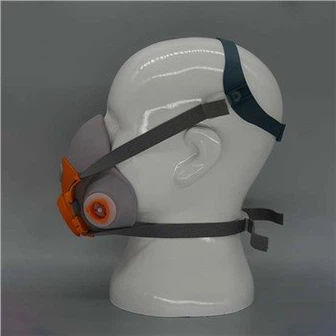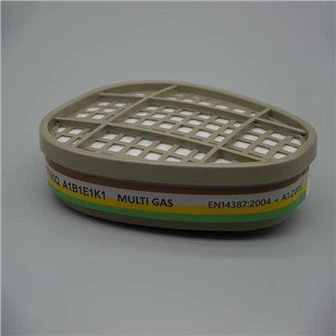
Half Facepiece Respirator Breathing Valve Technology: Comparison Of One-Way Valves Vs. Multi-Hole Valves
The breathing valve is a crucial component in half-face masks, directly impacting the wearer's breathing comfort and protection effectiveness. One-way valves and multi-hole valves are two common designs, each with unique advantages and suitable scenarios. Below is a detailed comparative analysis of these two technologies:
1. One-Way Valve Technology
 Working Principle
A one-way valve uses a movable film to control unidirectional airflow:
During exhalation: Air pressure pushes the film open, allowing exhaled air to escape quickly, reducing humidity and heat inside the mask.
During inhalation: The film closes, ensuring that external air can only enter through the filter, maintaining filtration efficiency.
Advantages
High exhaust efficiency: Low resistance during exhalation, ideal for high-intensity activities (e.g., sports, manual labor).
Reduced heat and humidity: Quickly expels hot and humid air, enhancing comfort during prolonged wear.
Simple structure: Easy to clean and maintain, suitable for repeated use.
Disadvantages
Unidirectional protection: Only filters inhaled air, not exhaled air, making it unsuitable for medical or epidemic prevention scenarios (potential pathogen transmission).
Durability issues: The film may degrade or break over time, affecting airtightness.
Applicable Scenarios
Industrial dust protection (e.g., construction, mining)
Outdoor sports (e.g., cycling, running)
Daily protection against smog
2. Multi-Hole Valve Technology
Working Principle
A multi-hole valve facilitates airflow exchange through multiple tiny holes:
During exhalation: Air slowly escapes through the holes, reducing internal pressure.
During inhalation: External air enters through the filter, while the holes contract due to negative pressure, minimizing the entry of unfiltered air.
Advantages
Bidirectional protection: Filters both inhaled and partially exhaled air, suitable for medical or epidemic prevention scenarios.
Stable structure: No moving parts, highly durable, and less prone to damage.
Lightweight design: Typically lighter than one-way valves, ideal for prolonged wear.
Disadvantages
Lower exhaust efficiency: Higher resistance during exhalation, which may cause discomfort during high-intensity activities.
Cleaning difficulty: Holes can accumulate dust or dirt, making cleaning challenging.
Applicable Scenarios
Medical protection (e.g., surgeries, infectious disease control)
Laboratory environments (e.g., chemical experiments, biosafety)
Daily protection (e.g., pollen allergies, air pollution)
3. Comparison Summary
| Feature | One-Way Valve | Multi-Hole Valve |
|---|---|---|
| Working Principle | Film controls unidirectional airflow | Multiple holes enable bidirectional airflow exchange |
| Exhaust Efficiency | High (suitable for high-intensity activities) | Lower (may feel stuffy) |
| Protection Performance | Unidirectional (only filters inhaled air) | Bidirectional (partially filters exhaled air) |
| Comfort | Low heat and humidity, suitable for prolonged wear | Lightweight but may feel stuffy |
| Durability | Film may degrade over time | Stable structure, highly durable |
| Cleaning and Maintenance | Easy to clean | Holes prone to dust accumulation, harder to clean |
| Applicable Scenarios | Industrial, sports, daily smog protection | Medical, laboratory, daily protection |
4. User Selection Guide
Choose One-Way Valves for:
High-intensity activities (e.g., running, cycling, manual labor).
Non-medical environments (e.g., industrial dust protection, daily smog protection).
Prioritizing heat and humidity comfort and exhaust efficiency.
Choose Multi-Hole Valves for:
Medical or epidemic prevention scenarios (e.g., hospitals, laboratories).
Bidirectional protection needs (e.g., preventing pathogen transmission).
Prioritizing durability and lightweight design.
5. Future Trends
Smart Breathing Valves: Integrate sensor technology to monitor breathing frequency and air quality in real time.
Hybrid Designs: Combine the advantages of one-way and multi-hole valves to develop new composite valve systems.
Eco-Friendly Materials: Use biodegradable materials to manufacture breathing valves, reducing environmental impact.