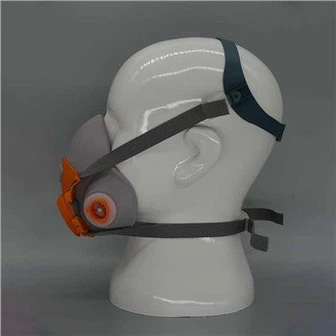
How to Choose the Right Half Facepiece Respirator for Industrial Chemical Applications
An industrial half facepiece respirator protects workers against specified airborne contaminants when paired with the correct filter or cartridge. For chemical applications, buyers must verify the contaminant, concentration, face seal, and filter compatibility. A P3 particulate filter does not protect against organic vapors unless used with an approved combination cartridge.
Identify the Chemical Hazards
Chemical processing, painting, metal treatment, and industrial cleaning can expose workers to dust, aerosols, gases, and vapors. Each hazard requires a suitable respiratory protection system.
| Application | Typical Hazard | Protection Requirement |
| Paint spraying | Organic vapors and paint mist | Approved vapor cartridge and particulate filter where required |
| Chemical handling | Gases, vapors, or aerosols | Cartridge approved for the identified chemical |
| Grinding | Fine particles and dust | Suitable particulate filter |
| Powder processing | Airborne chemical particles | Appropriate particulate filtration |
Check the chemical's Safety Data Sheet (SDS), occupational exposure limits, and expected concentration before selecting equipment.
Important: Air-purifying respirators do not supply oxygen. They must not be used in oxygen-deficient, unknown-concentration, or immediately dangerous to life or health (IDLH) environments.
Facepiece Material and Fit
Liquid silicone rubber (LSR) and thermoplastic elastomer (TPE) are common materials for reusable half facepiece respirators. Selection depends on comfort, cleaning requirements, chemical compatibility, and budget.
| Silicone vs. TPE | ||
| Feature | Silicone | TPE |
| Flexibility | Generally flexible across a broad temperature range | Depends on formulation |
| Skin Contact | Soft sealing surface | Flexible sealing surface |
| Cost | Often higher | Often more economical |
| Chemical Resistance | Depends on formulation and exposure | Depends on polymer formulation |
| Maintenance | Follow manufacturer instructions | Follow manufacturer instructions |
Neither material resists every chemical. Request compatibility data for the intended exposure and cleaning agents.
EN 140:1998 and Face Seal
For European procurement, verify compliance with EN 140:1998 and the product's applicable conformity documentation. Check the sealing surface, adjustable head straps, exhalation valve, and compatibility with other PPE.
Workers should complete the required fit testing and user seal checks. Facial hair crossing the sealing surface can prevent a reliable seal.
Request bulk pricing for industrial respirators
Match the Filter to the Contaminant
The facepiece and filter must form a compatible, approved system. A bayonet filter cartridge should only be used with a facepiece designed and approved for that connection.
| P1, P2 and P3 Filter Comparison | ||
| Class | General Use | Procurement Check |
| P1 | Lower-efficiency particulate filtration | Confirm suitability for the hazard |
| P2 | Medium-efficiency particulate filtration | Verify required protection level |
| P3 | High-efficiency particulate filtration | Check certification and compatibility |
Under the applicable EN 143 test requirements, P3 filters are commonly rated at at least 99.95% filtration efficiency. This laboratory rating does not represent the overall protection achieved on a worker.
Organic Vapor (OV) Cartridges
Organic vapor cartridges protect against specified vapors within their approved conditions. They cannot automatically be used for acid gases, ammonia, or other chemical groups.
| Hazard | Required Selection |
| Dust and particles | Approved particulate filter |
| Organic vapors | Compatible organic vapor cartridge |
| Vapors and aerosols | Approved combination filter |
| Multiple chemical gases | Cartridge approved for the identified contaminants |
Replace filters according to manufacturer instructions and the workplace change schedule. Do not rely on odor alone to determine when a vapor cartridge needs replacement.
B2B Checklist for Respirator Procurement
A reliable chemical respirator supplier should provide verifiable technical documentation, consistent production, and clear OEM terms.
| Item | What Buyers Should Verify |
| Facepiece | Applicable EN 140 requirements |
| Particulate filter | EN 143 classification |
| CE documentation | Valid documents for the exact product |
| Compatibility | Approved facepiece and cartridge combination |
| OEM service | Logo, labels, and packaging |
| Quality control | Batch traceability and inspection records |
| Commercial terms | MOQ, lead time, and repeat-order capacity |
Before mass production, approve the final facepiece, cartridge, labeling, and packaging. Changes to materials or connections may affect product certification.
Choosing a China Respirator Manufacturer
When comparing manufacturers, assess documentation and product consistency alongside price. Request technical specifications, conformity documents, cartridge compatibility details, OEM options, and production lead times.
Explore half facepiece respirator category and CE P3 filter cartridges for available product options.
Conclusion
Selecting an industrial half facepiece respirator starts with identifying the chemical hazard and required protection. Silicone and TPE offer different material and cost characteristics, while P3 filters and organic vapor cartridges address different contaminants.
Verify certification, fit, cartridge compatibility, and replacement requirements before placing bulk orders.
Request OEM Pricing for Half Facepiece Respirators and P3 Filters to discuss specifications, documentation, private labeling, and wholesale supply.
FAQ
Q: What is the MOQ for OEM half facepiece respirators?
A: MOQ depends on the model, material, logo, and packaging. Request a quotation based on your order quantity and customization requirements.
Q: Can the supplier provide CE certificates and test reports?
A: Request applicable conformity documents and test reports for the exact product. Verify their scope and validity before ordering.
Q: Can a P3 filter protect against organic vapors?
A: No. P3 filters provide particulate filtration. Organic vapors require a compatible, approved vapor cartridge; mixed hazards may require a combination filter.