Portable Water Flosser vs. Home Countertop Water Flosser: Which Is Better for Different Scenarios?
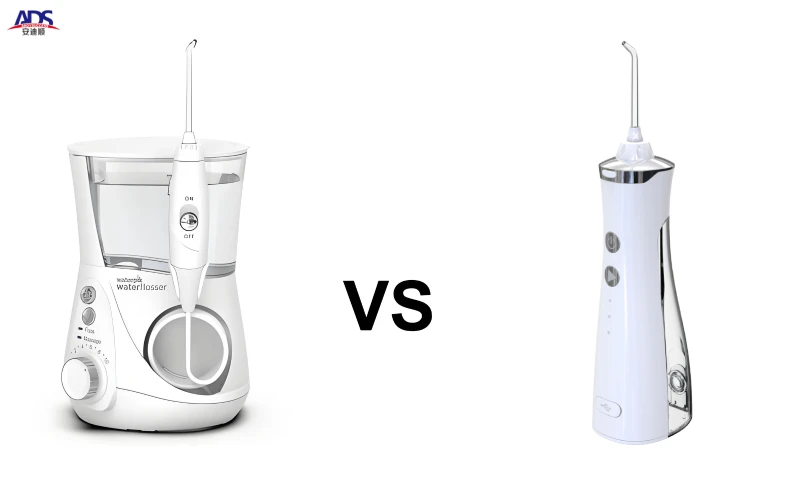
Portable vs. Countertop Water Flossers: Scenario-Based Recommendations and Key Differences
When choosing a water flosser, the main differences between portable and countertop models lie in size, water pressure performance, battery life, and usage scenarios. Below is a scientific comparison and scenario-based guide:
1. Core Parameter Comparison
| Feature | Portable Water Flosser | Countertop Water Flosser |
|---|---|---|
| Size/Weight | Palm-sized, 200–300g | Larger, 500–800g (requires fixed placement) |
| Water Pressure Range | Typically 20–75 PSI (limited by motor) | 10–100 PSI (adjustable with precision) |
| Water Tank Capacity | 100–200ml (requires refilling) | 600–1000ml (single fill for full cleaning) |
| Battery Life | Wireless, 7–30 days (rechargeable) | Plug-in, unlimited runtime |
| Target Users | Orthodontic patients, sensitive gums | Families, deep-cleaning needs |
| Noise Level | 50–60 dB (smaller motor) | 65–75 dB (high-pressure water flow) |
2. Scenario-Based Recommendations
1. Best Use Cases for Portable Models
Travel/Business Trips:
No power needed; easy to carry (e.g., planes, hotels).
Example: Panasonic EW-DJ10 (foldable design, 220g).
Office Use:
Quick post-meal cleaning to prevent food residue and bad breath.
Example: Philips Cordless Go (30-second quick-clean mode).
Light Orthodontic Care:
Temporary cleaning for braces or aligners after meals.
Note: Requires orthodontic tips (e.g., Waterpik WF-03).
Sensitive Gums:
Low-pressure mode (20–30 PSI) reduces bleeding risk.
Limitations:
Insufficient pressure for deep periodontal pockets.
Small tank requires 2–3 refills for full-mouth cleaning.
2. Countertop Models: Unique Advantages
Family Sharing:
Supports multiple tips (periodontal, tongue, implant-specific).
Example: Waterpik GT2-1 (7 tips, user memory function).
Deep Periodontal Care:
High-pressure pulses (70–100 PSI) remove plaque below 4mm gumline.
Clinical data: Countertop models reduce periodontal pocket depth by 1.5mm (JCP, 2021).
Implant/Denture Cleaning:
Adjustable pressure (40–60 PSI) protects implant seals.
Large-Capacity Needs:
No interruptions; 600ml tank cleans full mouth in one go.
Limitations:
Noisier (may disturb others at night).
Requires counter space; unsuitable for small bathrooms.
3. Decision Tree: How to Choose?
Frequent mobility needed?
Yes → Portable (prioritize battery life >15 days, e.g., Soocas W3).
No → Countertop (focus on pressure settings and tip compatibility).
Periodontal disease/implants?
Yes → Countertop (requires high pressure + specialized tips).
No → Portable (sufficient for daily use).
Family or individual use?
Family → Countertop (multi-user tips + large tank).
Individual → Choose based on scenarios.
4. Tech Innovation Trends
Portable High-Pressure Models:
E.g., Bixdo Capsule (75 PSI + magnetic charging).
Smart Countertop Models:
Waterpik AI Series: Detects bleeding points via app and auto-adjusts pressure.
Modular Designs:
Portable models with detachable tanks (e.g., Usmile C1) for home/travel flexibility.
5. Final Recommendations
Dual-Device Setup: Periodontal patients can pair a countertop (morning/evening deep cleaning) with a portable (daytime maintenance).
Trial Strategy: New users should start with countertop (low-pressure mode) to build habits, then expand as needed.